新書推薦:
《
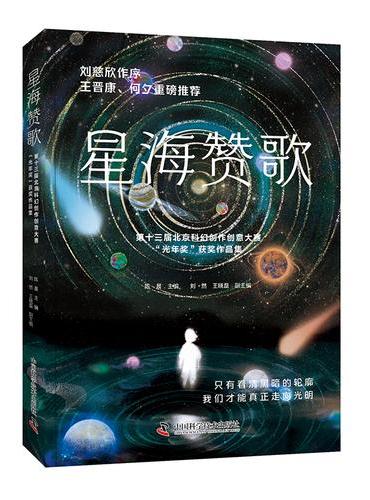
星海赞歌(第十三届北京科幻创作创意大赛“光年奖”获奖作品集)
》
售價:HK$
96.8

《
沪派江南·古今桥韵——高颜值的文化瑰宝
》
售價:HK$
107.8

《
中产阶级的孩子们:六十年代与文化领导权
》
售價:HK$
107.8

《
谈鬼说神
》
售價:HK$
398.2

《
走出秦制:清末民初六十年(慈禧、奕?、李鸿章、张之洞、袁世凯、康有为、梁启超、宋教仁等对中国前途的思
》
售價:HK$
129.8
《
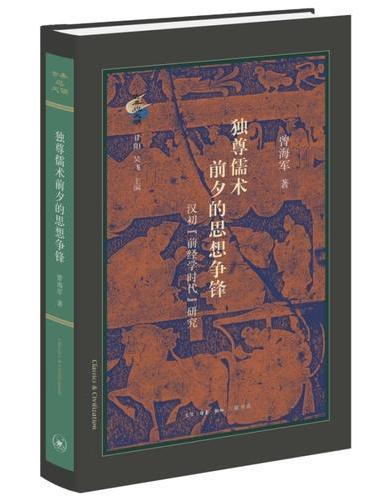
古典与文明·独尊儒术前夕的思想争锋:汉初“前经学时代”研究
》
售價:HK$
99.0

《
史记 全六册
》
售價:HK$
437.8
《
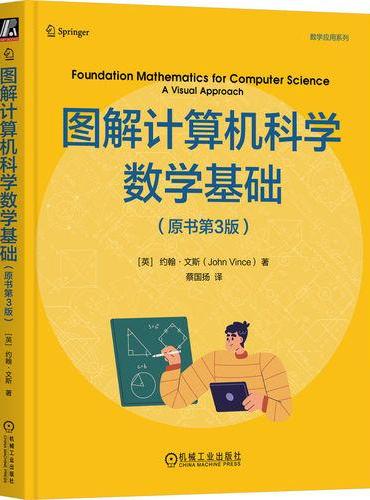
图解计算机科学数学基础(原书第3版)
》
售價:HK$
130.9
|
| 內容簡介: |
|
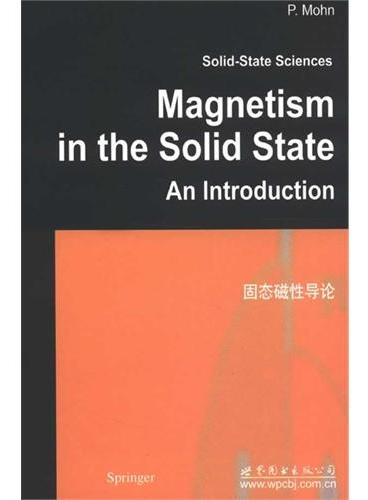
《固态磁性导论(英文版)》是一部从现象学研究出发,讲述固态磁性理论的教程。从引入统计热动力学和电子结构理论的基本概念开始,第一部分讨论了局部矩(Weiss,Heisenberg)和非定域矩(Stoner),紧接着用一章篇幅讲述了金属中的交换和相关内容,重申了局部和非局部极限的有关结果。最后,以自旋涨落结束,并将这章作为学习有限温度Stoner理论的开始。
|
| 目錄:
|
1. A Historical Introduction
2. Consequences ofFermi Statistics
2.1 Quantum Statistics of Fermions
2.2 Free Energy of the Fermi Gas
3. Paramagnetism
4. Energy Bands in the Crystal
5. Experimental Basis of Ferromagnetism
5.1 Nickel Alloys
5.2 Iron Alloys
5.3 Palladium Alloys
5.4 Iron-Nickel Alloys
5.5 Effects of Strong Magnetic Fields
5.6 Effects of High Pressure
5.7 Effects of Finite Temperature
5.8 Susceptibility above Tc
5.8.1 Susceptibility of “Classical Spins”
5.9 Critical. Exponents
5.10 Neutron Diffraction
5.11 Further Experimental Methods
6. Weiss Molecular Field Model
6.1 Rhodes-Wohlfarth Plot
7. Heisenberg Model
7.1 Magnon Operators
7.2 Heisenberg Hamiltonian in Magnon Variables
7.3 Magnon Dispersion Relation
7.3.1 Specific Heat of Magnons
7.3.2 Ordering Temperature
7.4 Approximations for the Heisenberg Model
7.4.1 Ising Model
7.4.2 XY Model
7.4.3 Mean Field Solutions of the Heisenberg Model
8. Itinerant Electrons at O K
8.1 Pauli Susceptibility of the Itinerant Electrons
8.2 Susceptibility of the Interacting Itinerant Electrons
8.3 Non linear Effects
8.4 Effects of IIigh Fields at O K
8.4.1 Non-magnetic Limit
8.4.2 Strong Ferromagnets
8.4.3 Weak Ferromagnets
8.4.4 bcc Iron and hcp Cobalt
8.4.5 Extremely High Fields
8.4.6 Metamagnetism
8.5 Susceptibility of Paramagnetic Alloys
9. Band Gap Theory of Strong Ferromagnetism
9.1 Magnetism of Alloys
10. Magnetism and the Crystal Structure——Covalent Magnetism
10.1 Crystal Structure of Mn,Fe,Co,and Ni
10.2 Covalent Magnetism
10.3 Covalent Polarization
11. Magnetic Impurities in an Electron Gas
11.1 Impurity Potential in the Jellium
11.2 Strong Perturbations in the Jellium
11.3 Layer and Line Defects
11.4 Magnetic Impurities and Oscillations of the
Magnetization
12. Itinerant Electrons at T〉O: A Historical Survey
12.1 Excitations at Low Temperatures
12.1.1 Strongly Ferromagnetic Systems
12.1.2 Weakly Ferromagnetic Systems
12.2 Stoner Theory for a Rectangular Band
12.3 Weak Excitations with ζ〈〈1
13. Hubbard Model
13.1 Beyond Hartree-Fock
14. Landau Theory for the Stoner Model
14.1 General Considerations
14.2 Application to the Stoner Model
15. Coupling Between Itinerant and Localized Moments
16. Origin of the Molecular Field
16.1 Heitler-London Theory for the Exchange Field
16.1.1 Magnetism of a Spin Cluster
16.1.2 Spinwaves for Localized Electrons
17. Exchange and Correlation in Metals
17.1 Free Electron Gas
17.2 Tightly Bound Electrons
18. Spin Fluctuations
18.1 Fluctuations of a Thermodynamical Variable
18.2 Fluctuations of the Magnetic Moment
18.3 Specific Heat of the Spin Fluctuations
18.4 Magneto-Volume Coupling
18.5 Applications of the Spin Fluctuation Model
18.6 Comparing the Spin-Fluctuation and the Stoner-Model
19. Single Particle Excitations Versus Spin Waves
20. Landau-Ginzburg Model for Spin Fluctuations
21. Conclusion and Lookout
A. Appendices
A. Convexity Property of the Free Energy
B. Derivation of the Coefficient a in (3.17)
C. Quenching of the Orbital Momentum
D. Properties of “Classical” Spins
E. Derivation of the Constant c in (8.24)
F. Ornstein-Zernicke Extension
G. Bogoliubov-Peierls-Feynman Inequality
H. The Factor 2 in Equation (7.27)
I. Hund‘s Rules
J. Polynomial Coefficients in (18.12)
K. Conversion Between Magnetic Units
References
Index
|
|

 購物車/收銀台(0) | 在線留言板
| 付款方式
| 運費計算
| 聯絡我們
| 幫助中心 |
加入書簽
購物車/收銀台(0) | 在線留言板
| 付款方式
| 運費計算
| 聯絡我們
| 幫助中心 |
加入書簽 HOME
HOME 新書上架
新書上架 暢銷書架
暢銷書架