新書推薦:

《
心灵银行手账 : 创造真正改变的卓越系统 世界级催眠大师约翰·卡帕斯博士上世纪90年代收费75万美金
》
售價:HK$
74.8

《
档案中的虚构:16世纪法国的赦罪故事及故事的讲述者(人类学与新文化史研究经典力作)
》
售價:HK$
74.8

《
AI社会 : 智能改变世界的十个场景(在这场AI革命中,你是否正在把命运悄悄交给看不见的算法?)
》
售價:HK$
74.8

《
名侦探的咒缚(东野圭吾:反推理?推理,东野写不下去了吗?这就是答案!一本让人泪流满面的奇幻悬疑)
》
售價:HK$
60.5

《
亚历山大在世界尽头
》
售價:HK$
88.0

《
生命的法则(2026年版)
》
售價:HK$
120.9

《
守护我们终将衰退的大脑:阿尔茨海默病防治全书 (一线医生写给中国家庭的阿尔茨海默病防治指南)
》
售價:HK$
64.9

《
精准表达:一说就懂的四句沟通术
》
售價:HK$
65.8
|
| 目錄:
|
1 Introduction
2 LES Governing Equations
2.1 Preliminary Discussion
2.2 Governing Equations
2.2.1 Fundamental Assumptions
2.2.2 Conservative Formulation
2.2.3 Alternative Formulations
2.3 Filtering Operator
2.3.1 Definition
2.3.2 Discrete Representation of Filters
2.3.3 Filtering of Discontinuities
2.3.4 Filter Associated to the Numerical Method
2.3.5 Commutation Error
2.3.6 Favre Filtering
2.3.7 Summary of the Different Type of Filters
2.4 Formulation of the Filtered Governing Equations
2.4.1 Enthalpy Formulation
2.4.2 Temperature Formulation
2.4.3 Pressure Formulation
2.4.4 Entropy Formulation
2.4.5 Filtered Total Energy Equations
2.4.6 Momentum Equations
2.4.7 Simplifying Assumptions
2.5 Additional Relations for LES of Compressible Flows ..
2.5.1 Preservation of Original Symmetries
2.5.2 Discontinuity Jump Relations for LES
2.5.3 Second Law of Thermodynamics
2.6 Model Construction
2.6.1 Basic Hypothesis
2.6.2 Modeling Strategies
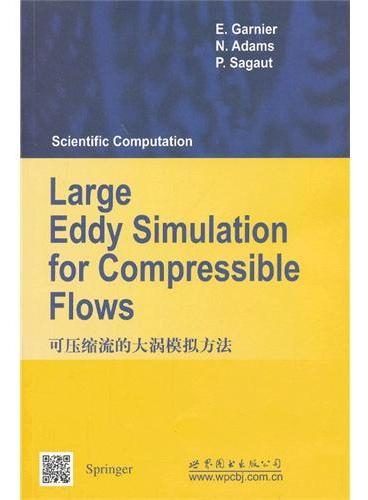
E. Gamier et al., Large Eddy Simulation for Compressible Flows,
Scientific Computation,
Springer Science + Business Media B.V. 2009
3 Compressible Turbulence Dynamics
3.1 Scope and Content of This Chapter
3.2 Kovasznay Decomposition of Turbulent Fluctuations
3.2.1 Kovasznay''s Linear Decomposition
3.2.2 Weakly Nonlinear Kovasznay Decomposition
3.3 Statistical Description of Compressible Turbulence
3.4 Shock-Turbulence Interaction
3.4.1 Introduction to the Linear InteractionApproximation Theory
3.4.2 Vortical Turbulence-Shock Interaction
3.4.3 Mixed-Mode Turbulence-Shock Interaction
3.4.4 Consequences for Subgrid Modeling
3.5 Different Regimes of Isotropic Compressible Turbulence
3.5.1 Quasi-Isentropic-Turbulence Regime
3.5.2 Nonlinear Subsonic Regime
3.5.3 Supersonic Regime
3.5.4 Consequences for Subgrid Modeling
4 Functional Modeling
4.1 Basis of Functional Modeling
4.1.1 Phenomenology of Scale Interactions
4.1.2 Basic Functional Modeling Hypothesis
4.2 SGS Viscosity
4.2.1 The Boussinesq Hypothesis
4.2.2 Smagorinsky Model
4.2.3 Structure Function Model
4.2.4 Mixed Scale Model
4.3 Isotropic Tensor Modeling
4.4 SGS Heat Flux
4.5 Modeling of the Subgrid Turbulent Dissipation Rate
4.6 Improvement of SGS models
4.6.1 Structural Sensors and Selective Models
4.6.2 Accentuation Technique and Filtered Models
4.6.3 High-Pass Filtered Eddy Viscosity
4.6.4 Wall-Adapting Local Eddy-Viscosity Model
4.6.5 Dynamic Procedure.
4.6.6 Implicit Diffusion and the Implicit LES Concept
Explicit Structural Modeling
5.1 Motivation of Structural Modeling
5.2 Models Based on Deconvolution
5.2.1 Scale-Similarity Model
5.2.2 Approximate Deconvolution Model
5.2.3 Tensor-Diffusivity Model
5.3 Regularization Techniques
5.3.1 Eddy-Viscosity Regularization
5.3.2 Relaxation Regularization
5.3.3 Regularization by Explicit Filtering
5.4 Multi-Scale Modeling of Subgrid-Scales
5.4.1 Multi-Level Approaches
5.4.2 Stretched-Vortex Model
5.4.3 Variational Multi-Scale Model
Relation Between SGS Model and Numerical
Discretization
6.1 Systematic Procedures for Nonlinear Error Analysis
6.1.1 Error Sources
6.1.2 Modified Differential Equation Analysis
6.1.3 Modified Differential Equation Analysis in Spectral
Space
6.2 Implicit LES Approaches Based on Linear and Nonlinear Discretization Schemes
6.2.1 The Volume Balance Procedure of Schumamm
6.2.2 The Kawamura-Kuwahara Scheme
6.2.3 The Piecewise-Parabolic Method
6.2.4 The Flux-Corrected-Transport Method
6.2.5 The MPDATA Method
6.2.6 The Optimum Finite-Volume Scheme
6.3 Implicit LES by Adaptive Local Deconvolution
6.3.1 Fundamental Concept of ALDM
6.3.2 ALDM for the Incompressible Navier-Stokes Equations
6.3.3 ALDM for the Compressible Navier-Stokes Equations
7 Boundary Conditions for Large-Eddy Simulation of Compressible Flows
7.1 Introduction
7.2 Wall Modeling for Compressible LES
7.2.1 Statement of the Problem
7.2.2 Wall Boundary Conditions in the Kovasznay
Decomposition Framework: an Insight
7.2.3 Turbulent Boundary Layer: Vorticity and Temperature
Fields
7.2.4 Turbulent Boundary Layer: Acoustic Field
7.2.5 Consequences for the Development of Compressible Wall Models
7.2.6 Extension of Existing Wall Models for Incompressible Flows
7.3 Unsteady Turbulent Inflow Conditions for Compressible LES.
7.3.1 Fundamentals
7.3.2 Precursor Simulation: Advantages and Drawbacks
……
8 Subsonic Applications with Compressibility Effects
9 Supersonic Applications
10 Supersonic Applications with Shock-Turbulence Interaction
References
Index
|
|

 購物車/收銀台(0) | 在線留言板
| 付款方式
| 運費計算
| 聯絡我們
| 幫助中心 |
加入書簽
購物車/收銀台(0) | 在線留言板
| 付款方式
| 運費計算
| 聯絡我們
| 幫助中心 |
加入書簽 HOME
HOME 新書上架
新書上架 暢銷書架
暢銷書架